
 Switch
 Homepage
 facebook
 IG
 Other Hospital
 CMUH App
News and Award
About CMUH
CMUH Deepens Taiwan–Malaysia Collaboration in Stroke Care Integrated Healthcare and Smart Rehabilitation Bring Taiwan’s Medical and Healthcare Technologies to East Malaysia
China Medical University Hospital (CMUH), Taiwan, has continued implementing the New Southbound Policy in Health and Medical Cooperation for the fifth consecutive year. To promote knowledge exchange in stroke care between Taiwan and Malaysia, CMUH and its partner, UNIMAS Teaching Hospital, jointly organized the “WORLD STROKE DAY 2026 Symposium: Navigating Life After Stroke” on October 24. Under the theme “A Guide to Life After Stroke,” the forum brought together medical experts from Taiwan, Malaysia, and Australia to discuss stroke treatment, rehabilitation, and care strategies to help patients return to daily life.
Dr. Huang Hung-Yu, Attending Physician, Department of Neurology, CMUH, and Lin Chia-Cheng, Physical Therapist, Department of Rehabilitation, shared their clinical experience in acute stroke treatment, comprehensive post-stroke care, and smart technology-assisted gait training. Their presentations promoted the exchange and application of Taiwan’s integrated healthcare and smart rehabilitation technologies in East Malaysia.

▲China Medical University Hospital (CMUH) and UNIMAS Teaching Hospital jointly held the “2026 Stroke Rehabilitation and Care Forum” in Kuching on October 24. Under the theme “A Guide to Life After Stroke,” the forum brought together medical experts from Taiwan, Malaysia, and Australia to discuss stroke treatment, rehabilitation, and care strategies to help patients return to daily life. The event also showcased smart rehabilitation robotic technologies from HIWIN Technologies and Wistron Medical, extending CMUH’s “medical-industry collaboration” initiative to East Malaysia..
Multidisciplinary Integration: From Acute Treatment to Long-Term Recovery
Dr. Hung-Yu Huang presented “Acute Stroke and Post-Stroke Care in China Medical University Hospital,” introducing the multidisciplinary collaboration model involving neurology, emergency medicine, medical imaging, neurointervention, and rehabilitation teams.
For patients with acute ischemic stroke, CMUH provides rapid evaluation, intravenous thrombolytic therapy, and endovascular thrombectomy for eligible patients with large-vessel occlusion. The hospital performs more than 200 endovascular thrombectomy procedures annually. Beyond acute treatment, CMUH emphasizes long-term post-stroke care, including secondary prevention, vascular risk control, intracranial and extracranial stent treatment, rehabilitation coordination, and botulinum toxin therapy for post-stroke spasticity.
The hospital’s team also actively participates in international clinical trials, contributes to national stroke treatment guidelines, and supports regional stroke networks. These efforts establish an integrated care model extending from acute treatment to long-term recovery, supporting timely referral and standardized care for patients with acute cerebrovascular disease.
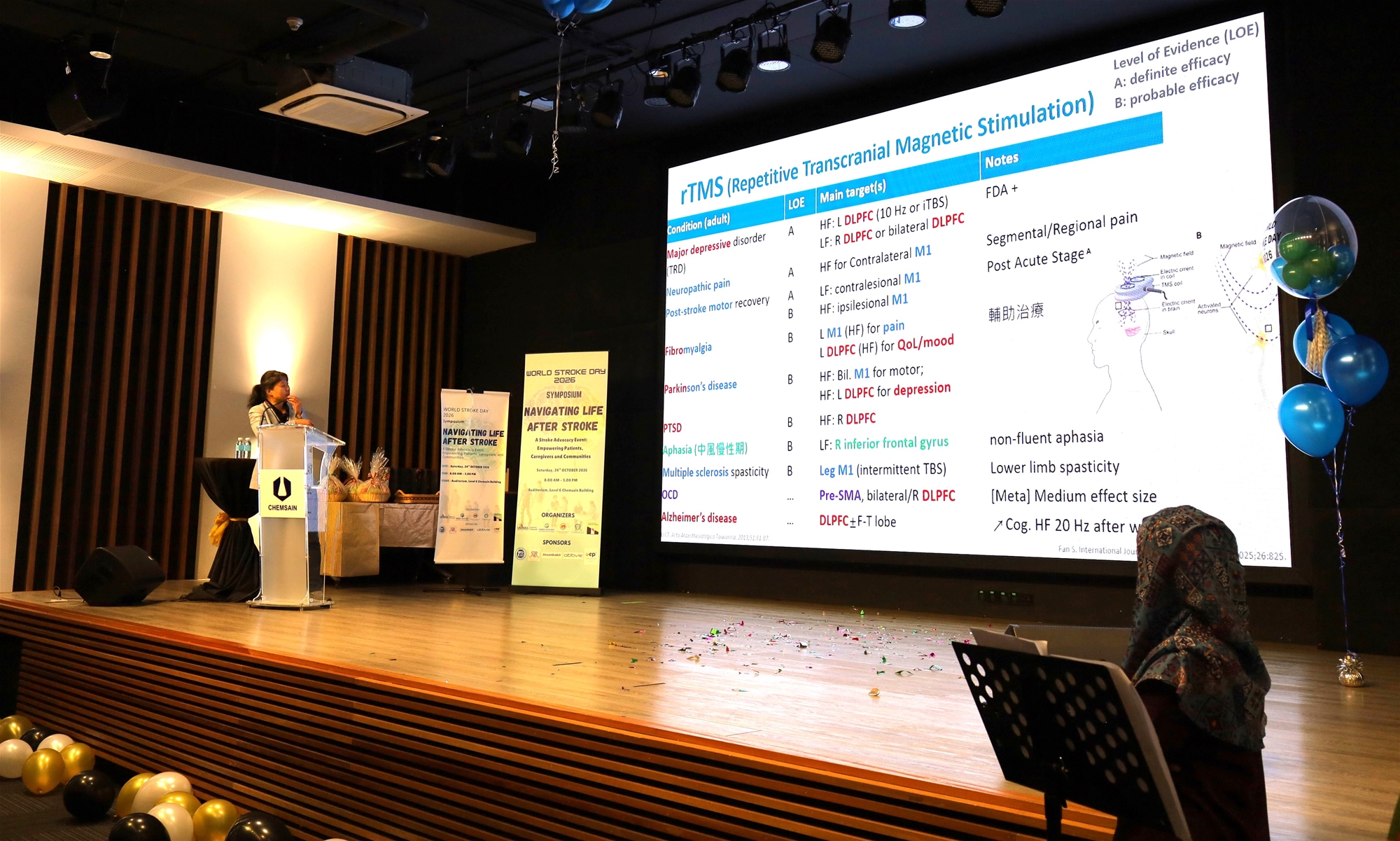
▲Dr. Huang Hung-Yu of the Stroke and Neurocritical Care Division, Department of Neurology, CMUH, delivered a presentation titled “Acute Stroke Treatment and Post-Stroke Care at CMUH.” She introduced the hospital’s multidisciplinary collaboration model involving neurology, emergency medicine, medical imaging, neurointervention, and rehabilitation teams.
Smart Technology in Rehabilitation Connects Taiwan’s Medical and Healthcare Industry
Lin Chia-Cheng, Physical Therapist, presented “Post-Stroke Rehabilitation: From Clinical Care to Smart Technology-Assisted Gait Training,” sharing Taiwan’s clinical experience in post-stroke rehabilitation and explaining how rehabilitation plans can be tailored to patients’ functional status and individual needs.
Post-stroke rehabilitation is a continuous process extending from the acute and subacute stages to the chronic phase, with the goals of restoring functional independence, improving mobility, and enhancing quality of life. Once patients are medically stable, the rehabilitation team evaluates their functional status and individual needs to develop appropriate interventions.
In addition to conventional rehabilitation, lower-limb rehabilitation robots and smart sensing technologies can provide more objective, quantitative, repetitive, and feedback-driven training. These technologies can increase training intensity, provide real-time feedback, and help therapists monitor gait performance and functional progress, enabling more individualized and effective post-stroke rehabilitation.
The forum also featured specialized workshops on lower-limb rehabilitation, cognitive rehabilitation, swallowing rehabilitation, and intensive care unit rehabilitation. Lin Chia-Cheng provided on-site guidance on operating smart rehabilitation equipment, facilitating the exchange of clinical practices and technology applications.

▲Lin Chia-Cheng, Physical Therapist and Section Chief of the Department of Physical Medicine and Rehabilitation at CMUH, presented “Post-Stroke Rehabilitation: From Clinical Care to Smart Technology-Assisted Lower-Limb Gait Training.” He explained how rehabilitation plans are tailored to patients’ functional abilities and individual needs, and shared positive clinical outcomes from the use of HIWIN Technologies’ lower-limb rehabilitation robots.
Strengthening Demonstration Sites in West and East Malaysia to Advance Clinical Application of Medical Technologies
Chou Aichi, Chief Executive Officer of the International Center at CMUH, stated that the hospital continues to connect Malaysian healthcare institutions, academic organizations, and Taiwan’s medical and healthcare industry to promote the practical application of medical technologies in Malaysia.
In 2025, CMUH facilitated the establishment of two product demonstration sites: a lower-limb rehabilitation robot demonstration site by HIWIN Technologies Corp. at Cheras Rehabilitation Hospital in Kuala Lumpur, and a Five-Sense Mirror telemedicine product demonstration site at Hospital Universiti Malaysia Sarawak in Kuching, East Malaysia.
In 2026, CMUH continued to strengthen the functions of both demonstration sites. During the first half of the year, the hospital organized the Fu’s Subcutaneous Needling Training Workshop and the Robot-Assisted Gait Training Workshop at Cheras Rehabilitation Hospital. In the second half of the year, the “2026 Stroke Rehabilitation and Care Forum” was held in Kuching, continuing the exchange of clinical expertise between Taiwan and Malaysia.
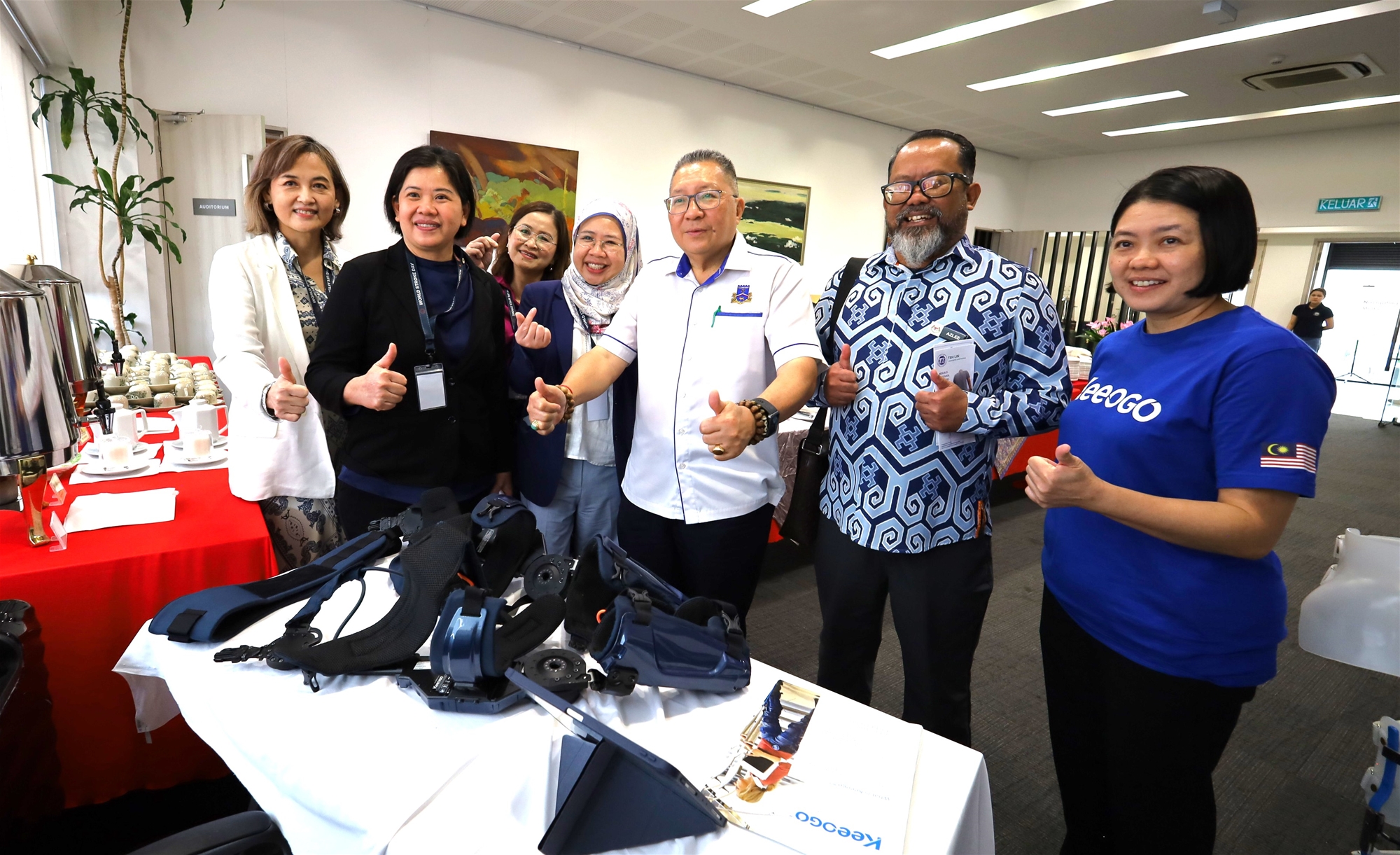
▲CMUH held the “2026 Stroke Rehabilitation and Care Forum” in Kuching, featuring Wistron Medical’s Keeogo lower-limb exoskeleton rehabilitation system. Dato’ Wee Hong Seng, Mayor of Kuching South City Council (third from right), visited the event to learn more about the technology.
In addition, equipment at the Five-Sense Mirror telemedicine demonstration site has been used to support healthcare services in remote areas of Sarawak and has received positive feedback. By the end of this year, CMUH plans to compile field application results and validation data to strengthen the evidence base for clinical applications and create more opportunities to promote Taiwan’s medical and healthcare technology products and expand partnerships in the Malaysian market.
CMUH will continue to place clinical needs at the center of its efforts, integrating medical expertise, smart technologies, and industry resources to deepen Taiwan–Malaysia healthcare cooperation. Through the exchange and application of integrated stroke care and smart rehabilitation technologies, CMUH aims to establish a more comprehensive and sustainable care support system for stroke patients and their families.
Related Articles


 Facebook
 IG
 YouTube